Medical Home Meeting: September 10, 2014

copy-copy-copy-bowling-3-e1354044194467.jpg

Dr. Matt Sadof (@MDSadof) launched our new season of meetings. We were nearly at “standing room only”.  We are amazed to see attendance rising with each year.

Dr. Sadof began by announcing good news.  Baystate Health recently received major funding from the Massachusetts Alliance for Coordinated Care.  Dr. Jack Maypole, from Boston Medical Center, is a co-investigator of a research project to develop a secure, individualized cloud-based method to record health care plans for families with medically complex children.  In addition to developing a mobile care plan, this grant will support the assignment of care coordinators, nutritionists, family navigators and other support staff to the enrolled families.  Care coordination is a critical part of the medical home concept.

After this announcement, our discussion turned to parents’ self-care.  Area events that are designed to give parents a night out (including massages, manicures, and chocolate fountains!) are poorly attended.  How can we encourage these loving caregivers to take a break?

The program continued with Doug McCallum taking the floor.  Doug is the Central/Western Regional Director of Family Support for the Massachusetts Department of Developmental Services.  He delivered a lively talk on DDS.  He reviewed eligibility guidelines, and talked about the expanded allowances for children with Pervasive Developmental Disorders (autism spectrum), as well as Prader-Willi and Smith-Magenis Syndromes.

Doug talked about the devastating cuts to Family Support in 2009, and the struggle to rebuild services.  Now, DDS is expanding services without a promise of additional funding.  He emphasized the importance of facilitating family-to-family sharing.  This work is done at the nine Family Support Centers in Western Massachusetts. For more information, check out www.mcsnet.org

DDS, in partnership with Massachusetts Families Organizing for Change, offers a Family Leadership Program

The MFOFC Family Leadership Series has a two-fold purpose. The first is to offer information about “best practices” for people with disabilities. The second is to assist families in creating a vision for their family member and a process to achieve the vision by incorporating that information.

Throughout the morning, Doug treated us to a full serving of DDS alphabet soup:  (FSC, IFFS, DESE/DDS, AWP).  For more information about these DDS programs, check out the mass.gov website.  

Mark your calendars!  Our Winter Fest will take place on Tue, Dec 2, 2014, from 4:30-6:30pm at the Shriners Hospital for Children, 516 Carew St., Springfield, MA.  

Medical Home Meeting: June 11, 2014

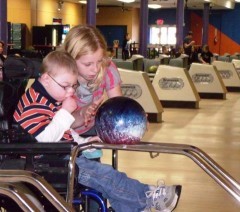
Our June meeting began with the incomparable Nancy Bazanchuk speaking on CHD’s Disability Resources.  Nancy’s programs serve people from “3-97 years old”.  The primary focus is helping people with physical and visual disabilities to participate in activities.  These activities include wheelchair soccer, sled hockey, adaptive golf and year-round bowling.  There are fees for most of the programs.  Family and friends are welcome to join in the fun.  All of the programs are out in the community and accessible by PVTA bus.  The programs teach physical activity skills as well as how to be a good team #highfive.

Nancy stressed the importance of getting kids active by the time they reach 12 years old.  If they are not in the habit, kids with disabilities can spend their adolescence and early 20’s sitting at home, depressed and bored.   Disability pride is a big part of all programs.

We concluded our meeting with a celebration of our 2013-2014 accomplishments and a look forward to 2014-2015. We will continue to meet on the second Wednesday of the month at Shriners. And, save the date for our Winter party: Dec 2, 2014. Lastly, encourage your networks to read our blog, follow us on Twitter @sncwma and like us on Facebook. We want to share good information with all of our families.

Here’s a wonderful interview with a young Western Mass athlete:

Medical Home Meeting: November 13, 2013

Our November meeting began with Denise Guilbeault, LICSW explaining the Medical Review Team.  In Massachusetts, the admission of a child into any of the three pediatric nursing facilities needs to be reviewed.  The Medical Review Team is composed of medical and human service agency representatives.  In order to qualify for long term placement, the child must have two discrete daily nursing care needs and developmental function scores of less than 12 months.  Short term respite care is available for families.  The nursing requirements are the same as long term placement, but the developmental profile is slightly higher, under 24 months.  Approval for respite care allows for up to 90 days at the facility.  As expected, summers and  holidays are the busiest time for respite requests.  MassHealth is the primary payor of respite services.

There is a real gap of services in Western MA; these pediatric nursing facilities are located in Billerica, Groton and Plymouth, MA.  Right now, there are about 25 beds available for respite care.  Without respite, families do suffer.

The initial application is very difficult, due to paperwork requirements.  Once the child is approved, the annual review is quite a bit easier.   The Medical Review Team offers a list of alternate community-based programs to families whose child does not qualify for admission to a pediatric nursing facility.  Many children will qualify for temporary placement after discharge from a hospital stay.  Hospitals develop the discharge plans, but the pediatric nursing facilities make the final decision on whether to admit a child or not.  Again, these services are located in Eastern MA.  For children having surgery in Boston, this is a viable option.

Next up:  Charles DiFazio, attorney with Sam’s food stores in Connecticut, spoke about Sam’s Children, Inc.

Sam’s Children is a small charity seeking to help families facing the chronic illness of a child.  This charity provides funding for diverse expenses associated with caring for children with medical conditions.  Sam’s Children tries to provide support within one week of the family’s request.  One example of support was the purchase of a generator for a family after the tornado in 2011.  The grant is given to the vendor, not the family.  This is a one-time opportunity to help families, and should not be seen as a source of on-going support.

Sam’s Children also donates food to the Ronald McDonald House.  Shriner’s Hospital and other area hospitals send referrals for funding to Sam’s Children.  Referrals come from doctors, nurses, social workers and other health care professionals.  The referral must explain the need to the charity board and give justification for funding.  The service area for Sam’s Children is Connecticut, Massachusetts and Rhode Island.  The charity is looking into providing services for New York families.

Several attendees at the Medical Home Work Group meeting spoke enthusiastically and warmly about the work done by Sam’s Children.